Silence As Technology: Simple Practices that Craft Presence and Community

July 9, 2026
Have you ever marveled at stone tools in a museum? They speak to our deep human impulse to create, to make, to solve, and apply. I was recently on Whidbey Island in Washington and wandered into the local historical society museum. I was mesmerized by the old baskets and tools created by human hands hundreds of years ago. It reminded me that we are all craft makers, developing objects and practices to produce an effect. Sensing a need, we create a way to respond, and a new technology emerges.
We’ve come to think of technology as something powerful and beyond our control, like algorithms, systems, and forces that shape human culture. But that’s a recent story. The word techne means craft. Imagine stone tools, gardens, songs, and rituals. These are all technologies.
At Commonweal, over the past 50 years, we’ve organically developed a set of simple technologies that we naturally use in everyday practice. We’ve never formally named them or defined them, but they’re carefully, kindly shared in practice. They help define who we are and, perhaps more importantly, work in a way that helps create the kind of world we want to live in.
Silence is perhaps the most profound technology we use. Commonweal founder Michael Lerner is known for stopping at the beginning of a meeting and saying, “Let’s go quiet.” We pause for a few seconds of silence and then he says something to welcome us back like, simply, “Peace. Peace.” Many of us use silence in similar ways to begin or close a meeting.
The first time I encountered this, it startled me. By the second time, I understood the value. Eventually, I tried it myself (tentatively) at a meeting I was convening, and soon it became quite natural. Now I offer it easily to people outside Commonweal, and I’ve yet to find someone who does not seem to appreciate a few moments to pause and go quiet. A few people have even told me that the silent pause is their favorite part of meeting with Commonweal. In a world of back-to-back Zooms, an invitation to actually land in the room can be a welcome gift!
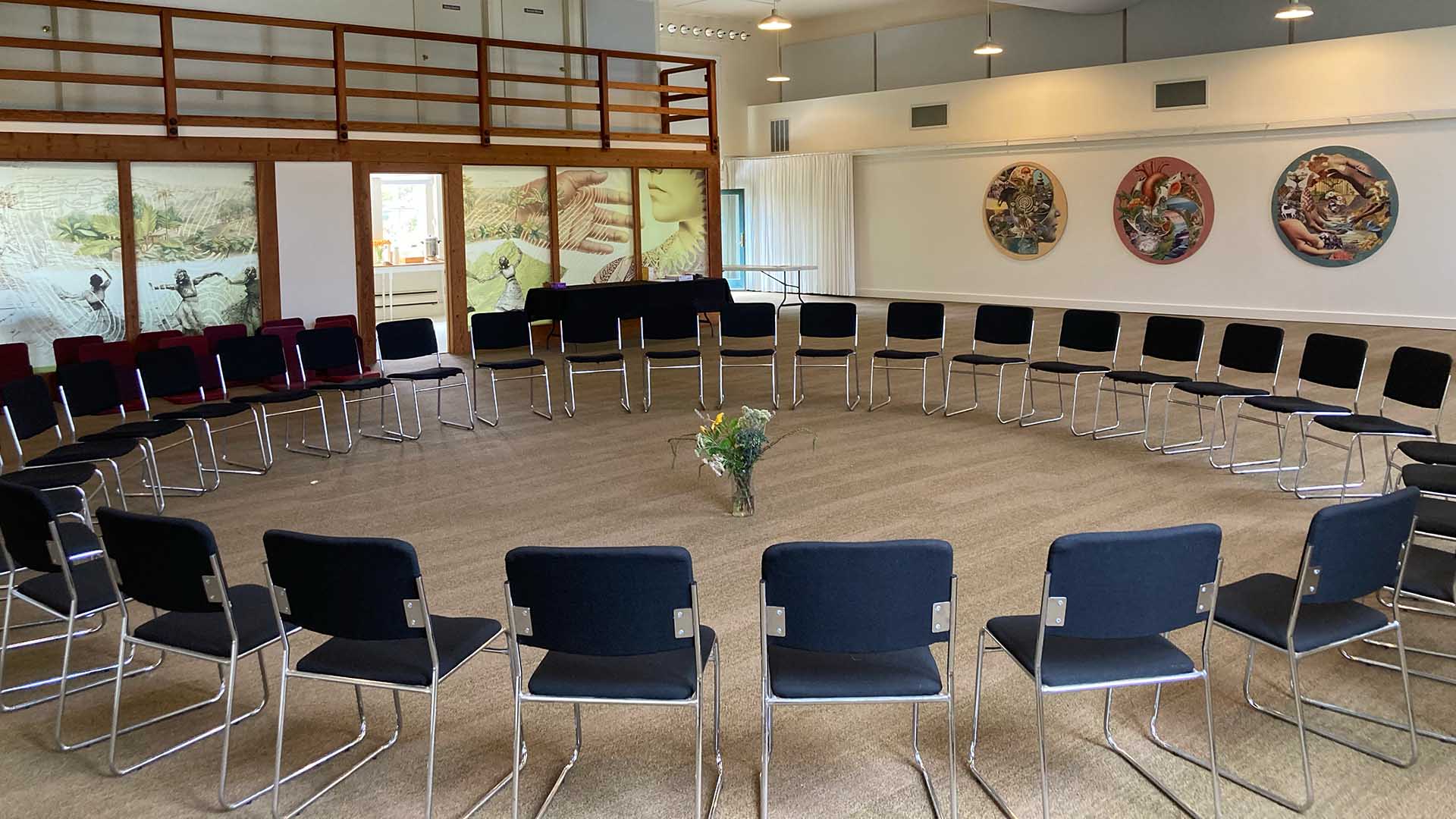
Gathering in a circle is another everyday Commonweal technology. A circle is our basic frame for large-group meetings. Our monthly staff meeting is a circle. When something rattles the culture, like a terrible violence or tragedy, we gather in a circle, sitting side-by-side and facing the center together. Years ago, we formalized this practice into a Commonweal program called Healing Circles Global, a structured program that spread virally and now hosts hundreds of circles daily around the world. This is something humans have done for centuries and still do because it is so simple and powerful.
Radical hospitality is a Commonweal technology that is perhaps hardest to name but easy to feel. We use the word “radical” to mean rooted. It goes beyond offering tea when someone arrives. It’s a way of welcoming people by tuning into what is present and tending to what is missing. There are practical aspects to this: We regularly host events and provide expected amenities like benches for rest and signs to help with wayfinding. It’s also a way of being that prioritizes kindness and grace with other humans. Our retreat center embodies this notion. Hundreds of people come each year to our retreat center and say it feels like coming home, which is a sure sign we are practicing deep welcome.
It is hard to imagine Commonweal without poetry. Poetry may be our favorite technology. Our monthly staff meetings begin and often end with a poem. Dear poet friends like Jane Hirshfield, Robert Haas, Allison Luterman, and David Whyte have come to Commonweal New School and graced our community with their words. Poetry transcends the intellectual and allows us to find common ground and tap into the realm of the imaginal.
This basket of practices is not wildly innovative or unusual, but they are part of what makes us Commonweal. These simple technologies help us smooth the rough edges of complex work. When we arrive jarred from the meeting before, three breaths of silence can land us in common space. When tragedy hits the news, a circle and a poem can reground us in what it means to be human. When a stranger arrives at our door, we say “welcome” to try to express a common kinship.
We developed our practices organically, never deciding consciously, guided only by shared values of kindness, compassion, and wisdom, and a desire to work in ways that support healing ourselves and the Earth.
What technologies do you use in your life and in the communities that matter to you? What practices will help you create the effect you want to see in the world?
You have the power to craft and shape the world you want to live in, using your own care and consciousness—your own wisdom—and your own basket of practices that you embody and share with your friends, family, and communities.
___
Top photo credit: Susan Grelock Yusem. Art credit: Jon Marro, in the Let's Go Quiet exhibit in Gallery Commonweal July - September, 2026